Should You Repair or Replace Your Roof? The Complete Decision Framework
A step-by-step framework for Gulf Coast homeowners to determine whether to repair, replace, or monitor their roof.
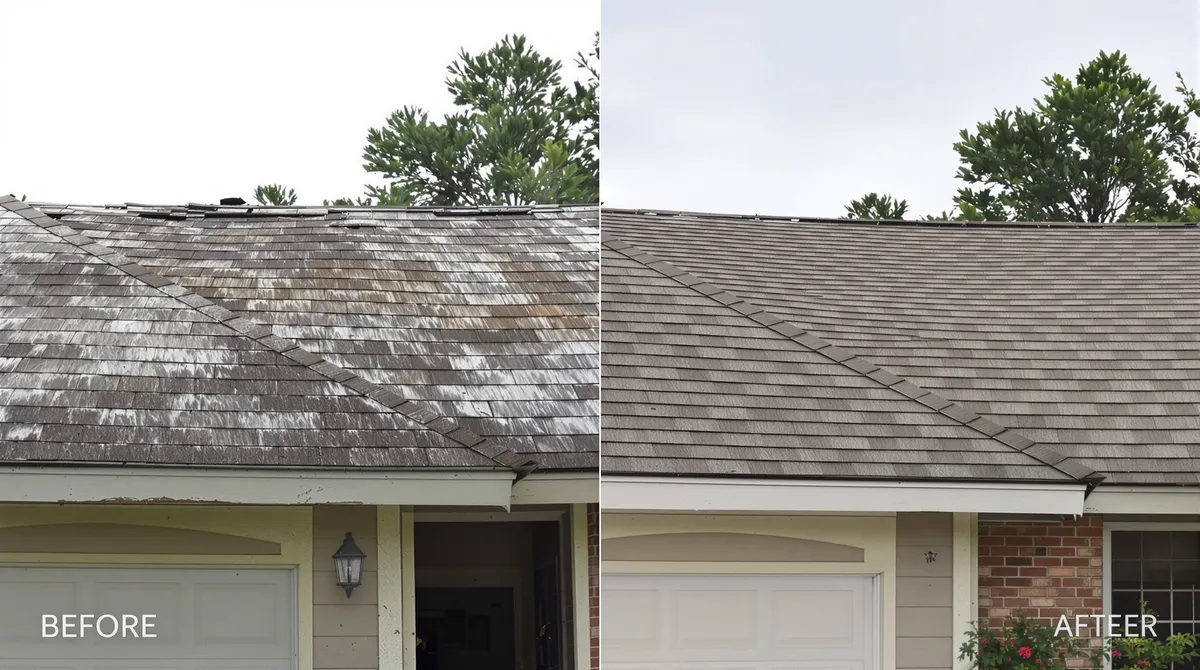
Most roofs don't need full replacement. If your roof is less than 15 years old and the damage is limited to one area, a targeted repair will almost always cost less and last long enough to justify the expense. But once a roof passes 75–80% of its expected lifespan — or when repair costs start climbing toward half the price of replacement — the math shifts decisively. This framework helps you figure out exactly where your roof falls.
What you'll learn
- How to assess your roof's age against its material-adjusted lifespan
- The decision logic professionals use to recommend repair vs replacement
- Gulf Coast-specific factors that accelerate roof aging
- The 50% rule and when cumulative repairs stop making financial sense
The Four-Factor Decision Framework
Professional roofers evaluate four things when deciding between repair and replacement. You can run through the same logic yourself. None of these factors alone gives you the answer — it's the combination that matters.
Factor 1: How Old Is Your Roof?
Roof age is the single biggest predictor of whether repair makes sense. Every roofing material has an expected service life, and where your roof sits on that timeline changes everything. A 5-year-old roof with storm damage is an obvious repair. A 25-year-old asphalt roof with the same damage is a different conversation entirely.
Here are realistic lifespans for materials common on the Gulf Coast. These already account for regional conditions — manufacturer warranties assume moderate climates, not subtropical ones.
- 3-Tab Asphalt Shingles: 12–18 years (rated 20–25)
- Architectural Shingles: 18–25 years (rated 25–30)
- Metal Standing Seam: 35–50 years (rated 40–60)
- Concrete/Clay Tile: 35–50 years (rated 50+)
- Flat/Low-Slope (TPO, Modified Bitumen): 12–18 years (rated 15–25)
The rule of thumb: if your roof has used less than 60% of its adjusted lifespan, repair is usually the right call. Between 60–80%, you're in the evaluation zone — consider the other three factors carefully. Past 80%, replacement typically wins unless the damage is truly minor.
Your 14-year-old architectural shingle roof has a few missing shingles after a storm. Based on age alone, should you lean toward repair or replacement?
Reveal answer
Repair. At 14 years, an architectural shingle roof on the Gulf Coast is at roughly 56–78% of its adjusted lifespan (18–25 years). That puts it in the repair-friendly zone or just entering the evaluation zone. A few missing shingles after a storm is a targeted, repairable issue.
Factor 2: What Kind of Damage Are You Seeing?
Damage scope matters more than damage severity. A single area with serious damage (even a large hole) is more repairable than minor damage spread across the entire roof. Here's why: when damage is localized, a roofer can match materials, integrate the repair with the existing system, and give you a meaningful warranty on the work. When damage is everywhere, you're essentially rebuilding the roof one patch at a time.
Localized damage that favors repair: missing shingles in one section, a single area of flashing failure, one penetration (vent pipe, skylight) that's leaking, wind damage confined to a slope or ridge line, impact damage from a fallen branch.
Widespread damage that favors replacement: granule loss across the entire surface, curling or buckling on multiple slopes, leaks appearing in different rooms, daylight visible through the decking in the attic, sagging or structural deflection anywhere.
One critical distinction on the Gulf Coast: hurricane damage often looks localized from the ground but is widespread on closer inspection. High winds can lift shingle edges across an entire roof face, breaking the tar seal strip without visibly removing shingles. Always get a close-up inspection after any named storm — what looks like "a few missing shingles" can actually be a roof that's compromised everywhere.
Factor 3: What Do the Numbers Say?
The financial analysis is where most homeowners get stuck. Repair seems cheaper because the upfront number is smaller. But roofing decisions aren't just about today's bill — they're about total cost over the remaining time you'll own the home.
The 50% rule is the standard threshold: if the repair estimate exceeds 50% of what a full replacement would cost, replace. This rule exists because at that price point, you're spending half the money for a fraction of the result. A repair gives you a patched old roof. A replacement gives you a complete new system with full warranty and current code compliance.
The 50% Rule in Action
Full replacement estimate: $16,000
Repair estimate: $4,200
Repair as % of replacement: $4,200 ÷ $16,000 = 26%
26% is well under 50%
This assumes the repair fully resolves the issue. If additional problems surface, recalculate.
But also track cumulative repair spending. If you've spent $3,000 on repairs in the last three years and now face another $2,500 bill, your total is $5,500. Compare that cumulative number against replacement cost, not just today's repair. Repeat repairs on an aging roof compound faster than most homeowners realize.
Factor 4: What's Your Future Plan?
How long you plan to stay in the home fundamentally changes the equation. If you're selling within two years, a repair that buys three years of life is a reasonable investment — you'll be gone before the next problem. If you're staying for 15 years, that same repair is just postponing a replacement you'll have to do anyway.
Insurance is an increasingly important factor on the Gulf Coast. In Florida, carriers are dropping homes with roofs over 15 years old regardless of condition. Alabama and Mississippi aren't as aggressive, but the trend is moving the same direction. A new roof doesn't just protect your home — it keeps you insurable. For some homeowners, this alone tips the decision.
Consider the FORTIFIED opportunity. If you're replacing anyway, upgrading to FORTIFIED Home standards (developed by IBHS) gives you enhanced wind and water protection. Some Gulf Coast insurers offer meaningful discounts for FORTIFIED designation. It adds $3,000–$8,000 to a replacement but can pay for itself in premium savings over 5–7 years.
You're planning to sell your Pensacola home in 18 months. The 17-year-old architectural shingle roof needs $4,500 in repairs. A full replacement would cost $18,000. What's the smart move?
Reveal answer
Probably repair. At $4,500 vs $18,000, the repair is 25% of replacement cost — well under the 50% threshold. Since you're selling in 18 months, you need the roof to last just long enough to get through the sale. However, factor in that Florida buyers and insurers will scrutinize roof age heavily. If the repair won't make the roof insurable for the next buyer, replacement may actually be necessary to close the sale.
Gulf Coast Factors That Change the Calculation
Generic roofing advice doesn't account for the conditions your roof actually faces. The Gulf Coast is one of the hardest environments in the country for roofing materials. Every factor in the decision framework above gets adjusted by these regional realities.
Hurricane Exposure
Wind isn't the only threat — it's the wind-driven rain that follows. A roof that "survived" a hurricane may still have compromised seals, lifted edges, and microperforations that lead to slow leaks for months afterward. Post-hurricane inspections frequently upgrade what looked like a repair into a replacement, and for good reason. A roof that's been through a major storm is fundamentally different from one that hasn't, even if it looks similar from the ground.
Humidity and Moisture
Gulf Coast humidity levels above 70% create persistent moisture conditions that accelerate every form of roof degradation. Algae growth (those dark streaks) isn't just cosmetic — it holds moisture against the shingle surface and shortens granule life. Underlayment deteriorates faster. Metal components corrode sooner. Ventilation problems that wouldn't matter in Arizona become critical failures here.
Salt Air Corrosion
Properties within 15 miles of the coast face accelerated corrosion of metal components: flashing, fasteners, drip edges, valley metal, and vent boots. Even "galvanized" components degrade faster in salt air. If you're coastal and repairing, insist on stainless steel or high-grade aluminum replacements, not standard galvanized. If you're replacing, specify coastal-rated components for the entire system.
Building Code Requirements
Florida, Alabama, and Mississippi all have updated building codes that affect replacement projects. In Florida, any replacement project triggers current Florida Building Code compliance, including enhanced wind resistance requirements. This is actually a benefit — a code-compliant replacement gives you a meaningfully stronger roof than whatever you're replacing. But it does add cost, which factors into the repair vs replace math.
Repair vs Replace at a Glance
| Factor | Repair | Replace |
|---|---|---|
| Best when roof is | Under 60% of lifespan | Over 80% of lifespan |
| Damage pattern | Localized (one area) | Widespread (multiple areas) |
| Typical cost | $300–$1,500 | $8,000–$25,000+ |
| Time to complete | 1–4 hours | 2–5 days |
| Warranty | Patch area only | Full manufacturer + workmanship |
| Insurance impact | Minimal | Can lower premiums significantly |
| Code compliance | Existing code applies | Must meet current code |
| Resale value | Maintains current value | Can increase appraised value |
When to Get a Professional Assessment
This framework gives you a solid starting point, but some situations genuinely need professional evaluation. You don't need a roofer for every question, but certain conditions are beyond what you can reliably assess from the ground or even from a careful attic inspection.
Get a professional involved when: you see sagging anywhere on the roof, active leaks are coming from multiple locations, storm damage occurred and you need documentation for insurance, the roof has two or more layers and you're unsure of the original material's condition underneath, or you've received conflicting advice from different contractors.
A word on contractor incentives: be aware that some contractors are financially motivated to recommend replacement over repair. Replacements are bigger jobs with higher profit margins. That doesn't mean every replacement recommendation is wrong — it means you should understand the reasoning. Ask specifically which of the four factors (age, damage scope, cost analysis, future planning) is driving the recommendation, and verify the logic yourself using this framework.
A contractor tells you that your 12-year-old architectural shingle roof 'needs to be replaced' after finding some damaged flashing around a chimney. Using the framework, what questions should you ask?
Reveal answer
At 12 years, an architectural shingle roof is only 48–67% through its adjusted Gulf Coast lifespan. The damage described (flashing around a chimney) is localized, not widespread. Ask: What is the specific scope of damage beyond the flashing? Is the decking sound? What would a repair cost vs replacement? Has the damage spread beyond the chimney area? A 12-year-old roof with one flashing issue is almost always a repair, not a replacement.
Frequently Asked Questions
- How do I know if my roof needs repair or full replacement?
- Start with age and damage scope. If your roof is under 60% of its expected lifespan and the damage is localized to one area, repair usually makes sense. If it's past 80% of its lifespan with widespread issues, replacement is typically the smarter investment. The decision framework on this page walks you through the full analysis.
- What is the 50% rule for roof replacement?
- The 50% rule says that if repair costs exceed 50% of what a full replacement would cost, you should replace instead. For example, if a new roof costs $15,000 and you're looking at $8,000 in repairs, replacement gives you a completely new system for only $7,000 more. Many insurance companies and building codes reference this threshold.
- Does the Gulf Coast climate affect the repair vs replace decision?
- Significantly. Gulf Coast roofs face hurricanes, sustained humidity, salt air corrosion, and intense UV exposure. These factors reduce material lifespans by 15–25% compared to inland areas. A 20-year shingle on the Gulf Coast may only perform reliably for 15–17 years. This compressed timeline shifts more borderline cases toward replacement.
- Can I just patch my roof until I'm ready to replace it?
- Sometimes, but it depends on the underlying condition. If the decking is sound, the damage is isolated, and you're buying 3–5 years of useful life, patching can be reasonable. If you're patching the same roof every year or the damage keeps spreading, those repair dollars are wasted — they won't transfer to the new roof.
- Should I replace my roof before hurricane season?
- If your roof is already in the replacement zone (past 80% of lifespan, showing widespread wear), getting it done before June 1 is smart. A new roof installed to current code gives you the best wind protection available. That said, don't rush into a replacement just because of the calendar — a roof in good condition with minor issues doesn't need emergency replacement.
- Will a new roof lower my homeowners insurance in Florida or Alabama?
- It can, but the savings vary widely. In Florida, a new roof that meets the Florida Building Code and earns wind mitigation credits can reduce premiums substantially — sometimes 20–40%. In Alabama and Mississippi, discounts exist but tend to be smaller. Always get a wind mitigation inspection after replacement and submit the form to your insurer.
- How many times can you repair a roof before replacing it?
- There's no fixed number, but track cumulative costs. Once you've spent more than 30–40% of a replacement cost on repairs within a 5-year window, the math usually favors replacing. Also watch for compounding issues — if each repair seems to reveal another problem, the roof is telling you something.
- Is it worth replacing a roof before selling my house?
- Often, yes — especially on the Gulf Coast where buyers and inspectors focus heavily on roof condition. A new roof removes the biggest negotiation lever a buyer has. It also makes your home insurable, which is increasingly non-negotiable in Florida. That said, run the numbers: a $15,000 roof that adds $12,000 in sale price might not justify the investment if you're in a hot market.
Want a Professional to Confirm?
If you've worked through the framework and want a professional assessment, Southern Roofing Systems provides honest evaluations for Gulf Coast homeowners. They'll tell you whether your roof needs repair, replacement, or just monitoring.
Request an Assessment