Granules in your gutters are pieces of your shingles. Every asphalt shingle is coated with ceramic granules that protect the underlying material from UV radiation, heat, and moisture. When those granules wash off and end up in your gutters, your shingles are losing their protective layer. The question is not whether granule loss is happening — it happens to every roof. The question is how fast.
The rate of loss is what separates normal aging from a problem. A light dusting of granules after a heavy rain is standard for any asphalt shingle roof. Thick accumulation that clogs your gutters or piles up at downspouts is your roof telling you that something is accelerating the process — and on the Gulf Coast, that acceleration is real.
What you'll learn
- Why granule loss happens and what it means for your roof's remaining life
- How to distinguish normal shedding from a problem that needs attention
- The specific Gulf Coast conditions that accelerate granule loss
- What your roof's age tells you about the significance of what you're seeing
- When to schedule an assessment vs. when to simply keep monitoring
What You're Seeing
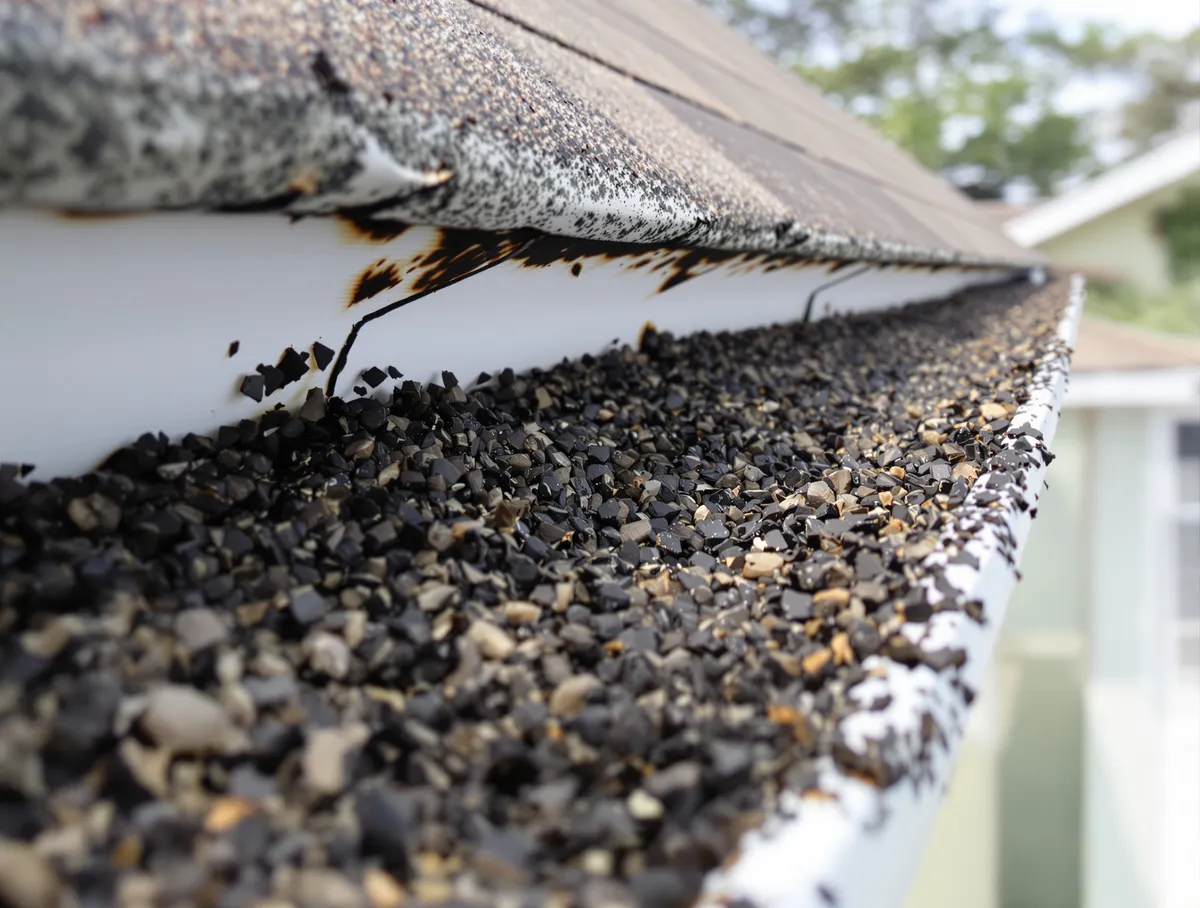
Granules look like coarse sand or fine gravel. They are small, hard, ceramic-coated particles — typically gray, black, brown, or a blend depending on your shingle color. You will find them in gutters, accumulated around downspout outlets, washed onto driveways or walkways below the roofline, or collected in splash blocks.
On the roof itself, granule loss shows as dark or smooth patches. Where granules have washed away, the dark asphalt substrate becomes visible. From the ground, these areas look darker than the surrounding shingles, sometimes with a slight sheen where the surface has become smooth. With binoculars, you can often see the difference clearly.
Check the areas that get the most weather exposure. South-facing and west-facing slopes lose granules fastest on the Gulf Coast because they receive the most direct sun and heat. The bottom edges of shingles and areas with high water flow during rain also show accelerated loss. If one slope of your roof looks noticeably darker than the others, granule loss is the likely reason.
After a storm, check gutter accumulation specifically. A significant increase in granules after hail or heavy rain is different from gradual accumulation. Storm-related granule loss can be sudden and concentrated, and it may be relevant for an insurance claim.
What Causes This
1. Normal Aging
All shingles lose granules over their lifetime. This is expected. Asphalt shingles are manufactured with more granules than they strictly need, anticipating some loss over the product's life. In the first year, you may see more granules than usual — that is loose manufacturing residue washing away, not a sign of a problem.
After the initial shedding period, the rate should stabilize. You will see a small amount after heavy rains, but it should not be dramatically increasing year over year. When the rate picks up noticeably, the shingles are entering the latter portion of their service life.
2. Accelerated Weathering from Gulf Coast Conditions
The Gulf Coast climate is uniquely hard on shingle granules. Sustained high temperatures expand and contract the asphalt substrate daily, loosening the bond between the granules and the base material. UV radiation is intense here — more so than in northern states — and it degrades the binding agents that hold granules in place.
Heavy rain events are another factor. The Gulf Coast receives more annual rainfall than almost any region in the country. Each heavy rain physically washes granules off the surface. Combined with the heat and UV degradation that loosens them, the cycle of loosen-wash-loosen-wash is constant from May through October.
Humidity plays a role as well. Sustained moisture promotes algae growth on shingle surfaces. Algae colonies develop root-like structures that penetrate beneath granules, loosening them from the substrate. Those black streaks you see on Gulf Coast roofs are not just cosmetic — the algae underneath is actively dislodging granules.
3. Hail Damage
Hail physically knocks granules off the shingle surface. Each hail impact creates a bruise — a circular area where granules are dislodged or cracked. Small hail produces subtle damage that is difficult to see from the ground but shows clearly as accelerated granule accumulation in gutters. Large hail creates visible impact marks.
Post-hail granule loss is sudden and significant. If you notice a dramatic increase in gutter granules after a hail event, document it immediately. Hail damage is a covered insurance event, but you need to report it promptly. Have a roofer inspect — they know how to identify hail impact marks versus normal wear.
4. Manufacturing Defect
Some shingle batches leave the factory with insufficient granule adhesion. This is uncommon but not rare. The telltale sign is significant granule loss on a roof that is less than five years old with no storm damage history. If you suspect a manufacturing defect, your material warranty may cover replacement, but you will need a professional to document the condition and file the claim.
How Serious Is This?
Answer these three questions to get a severity assessment. Your roof's age is the single most important factor in interpreting what granule loss means.
1/3 How old is your roof?
2/3 How much granule accumulation are you seeing?
3/3 Can you see dark or bare patches on the shingles from the ground?
The key question is the rate of loss relative to your roof's age. Moderate granule loss on a 20-year-old roof is expected — the shingles are approaching end of life. The same amount of granule loss on a 7-year-old roof is a concern that warrants investigation. Heavy loss at any age deserves professional evaluation.
What to Do About It
Light Granule Loss — Any Age
Monitor and document. Light granule accumulation in gutters after heavy rain is normal for any asphalt shingle roof. Clean your gutters regularly so you can track changes. Take a photo of your gutters after a heavy rain twice a year — spring and fall — to create a baseline for comparison.
Moderate Granule Loss — Roof Under 15 Years
Check your attic ventilation. Premature granule loss on a younger roof almost always connects to excessive heat. If your attic is poorly ventilated, the shingles are baking from both sides — sun above, trapped heat below. Improving ventilation can slow granule loss and extend your roof's remaining life.
Look for algae growth. If you see black streaks on the shingles, algae is contributing to granule displacement. Soft washing (never pressure washing) can remove the algae and slow the loss. Zinc or copper strip installation along the ridge can prevent regrowth.
Moderate to Heavy Granule Loss — Roof Over 15 Years
Schedule a professional roof assessment. This level of granule loss on an aging roof is the shingles telling you they are approaching end of service. The assessment will tell you whether you have a year or five years remaining, which helps you plan financially for a replacement rather than being surprised by a sudden failure.
Heavy Granule Loss — Any Age
Get a professional evaluation within the month. If you can see obvious bare patches on the shingles from the ground, the protective layer is substantially compromised. Without granule protection, the asphalt will crack and deteriorate quickly — especially under Gulf Coast sun. On a newer roof, this may be a warranty issue. On an older roof, it is a timeline to replacement.
When to Call a Professional
- Visible bare patches on the shingles. Once you can see dark, smooth areas from the ground, the granule loss has progressed beyond normal aging.
- Gutters clogging with granule accumulation. If granules are thick enough to impede water flow through your gutters, the loss rate is high.
- Sudden increase after a storm. Post-storm granule loss may be hail damage, which is an insurance event that needs professional documentation.
- Roof is under 10 years old with more than light loss. This is premature and may indicate a defect, installation problem, or severe ventilation issue.
- You also see curling or cracking shingles. Granule loss combined with curling means the deterioration is advanced. Both symptoms together indicate the shingles are failing, not just aging.
You can continue monitoring if: the loss is light to moderate, your roof is over 10 years old, you see no bare patches from the ground, and you have no other symptoms like ceiling stains or curling. Document with photos, check quarterly, and keep an eye on the rate of change.
How This Connects to Other Roof Symptoms
Granule loss is the first step in a predictable deterioration sequence. Once the protective granule layer is substantially reduced, the exposed asphalt dries out, cracks, and curls. Curled shingles create gaps for water entry, leading to ceiling water stains. Over time, chronic water intrusion compromises decking and can contribute to sagging.
If you are seeing granule loss and curling shingles together, you are in the middle of that sequence. The deterioration has progressed past the early warning stage. If you also see missing shingles, the weakened material is now failing under normal weather stress. Each additional symptom moves you further along the urgency scale.
Granule loss on its own is the most treatable stage. Improving ventilation, addressing algae, and monitoring the rate of loss gives you the most time to plan. Once the downstream symptoms appear — curling, cracking, leaking — the window for low-cost intervention closes.
Frequently Asked Questions
- Is some granule loss normal?
- Yes. All asphalt shingles shed a small number of granules throughout their life. Brand new shingles shed loose manufacturing granules during the first year. After that, a light dusting is normal. The concern begins when you see heavy accumulation, visible bare spots on the shingles, or a sudden increase in the rate of loss.
- What do granules actually do?
- Granules serve three purposes: they protect the asphalt layer from UV radiation, they add fire resistance, and they provide the color and appearance of the shingle. Once granules are lost, the exposed asphalt deteriorates rapidly from sun exposure, accelerating the aging of the entire shingle.
- Can granule loss be caused by pressure washing my roof?
- Yes, and this is a common mistake. Pressure washing blasts granules off shingles and significantly shortens roof life. Soft washing with appropriate cleaning solutions is the only safe method for cleaning asphalt shingle roofs. If a cleaning company suggests pressure washing your shingles, find a different company.
- Does hail cause granule loss?
- Yes. Hail impact dislodges granules from the point of contact, creating circular bare spots on the shingle surface. After a hail event, you may see a sudden increase in granule accumulation in your gutters. Hail damage is covered by most homeowner insurance policies and should be documented and reported promptly.
- My roof is only 5 years old and I'm seeing granule loss. Is that a defect?
- It depends on the amount. Light shedding in the first few years is normal as loose manufacturing granules wash away. Heavy accumulation or visible bare patches on a 5-year-old roof is not normal and may indicate a manufacturing defect, improper installation, or severe ventilation problems. Document the condition and contact your roofing contractor — the workmanship warranty should still be in effect.
What Should You Do Right Now?
Check your gutters and take a photo. Look at the shingles from the ground with binoculars and note any dark or bare-looking patches. Record your roof's age if you know it. These three data points — gutter accumulation, shingle appearance, and roof age — tell you most of what you need to know about how serious this is.
If you are seeing heavy accumulation or bare patches, schedule a professional assessment. If the loss is light to moderate and your roof is not ancient, you have time to monitor. Either way, knowing where you stand now prevents a surprise later.